TDI / HUM.05 · simulates · The four instruments
HUM△NS™
Test your concept and your price before paying for fieldwork.
Before paying for fieldwork, focus groups or a new execution, HUM△NS lets you put an idea in front of profiles built on consumer survey data: a concept, a label, a price, a consumption occasion. It is not a substitute for a real person. It's meant to rule out weak hypotheses before you spend money testing them.
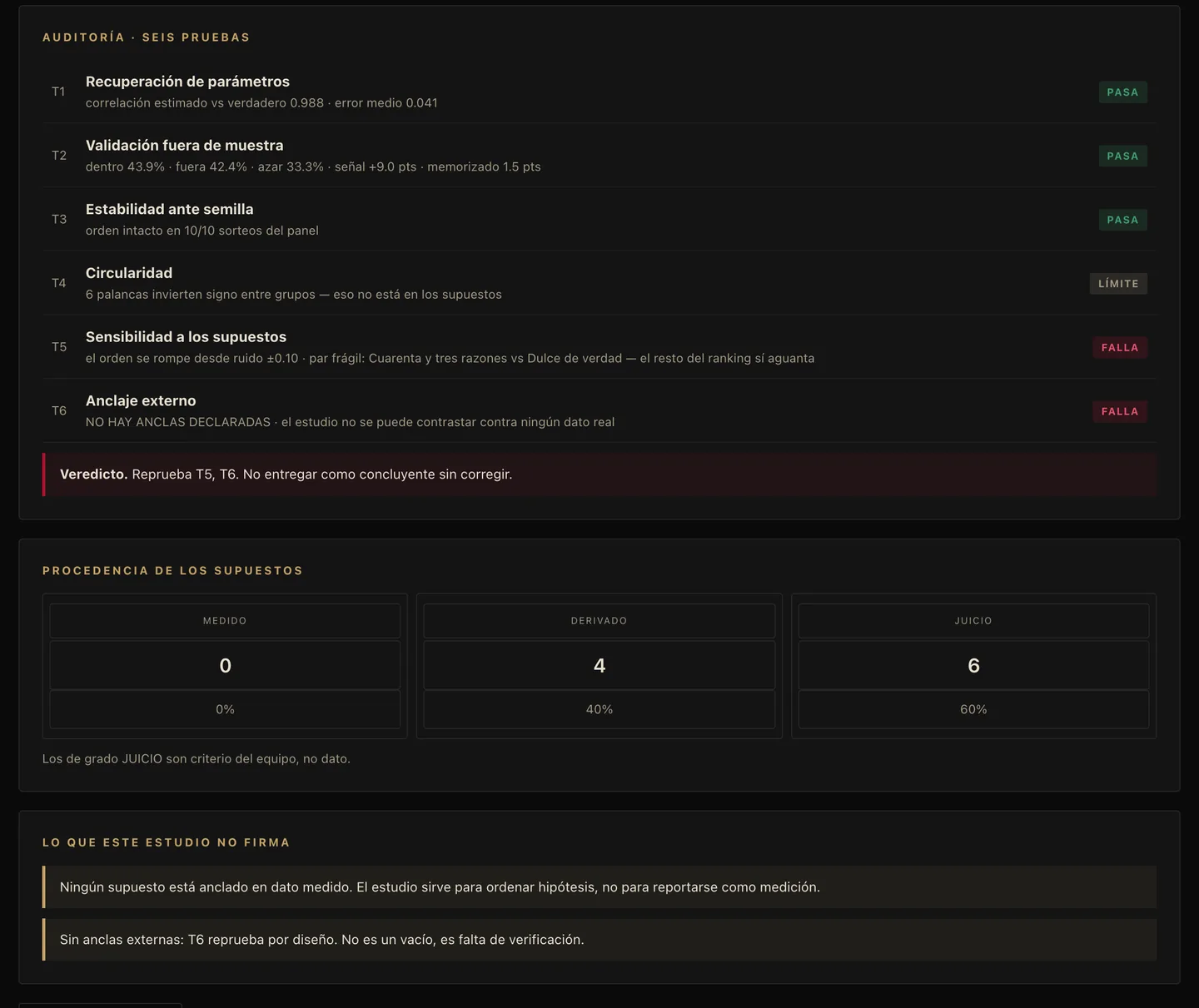
And every study goes through six tests and publishes the ones it fails: parameter recovery, out-of-sample validation, seed stability, circularity, assumption sensitivity, and external anchoring. One demo run failed two and wrote, on its own, «do not deliver as conclusive without correcting». Without an external data point to check it against, the anchoring test fails by design — and that gets printed too.
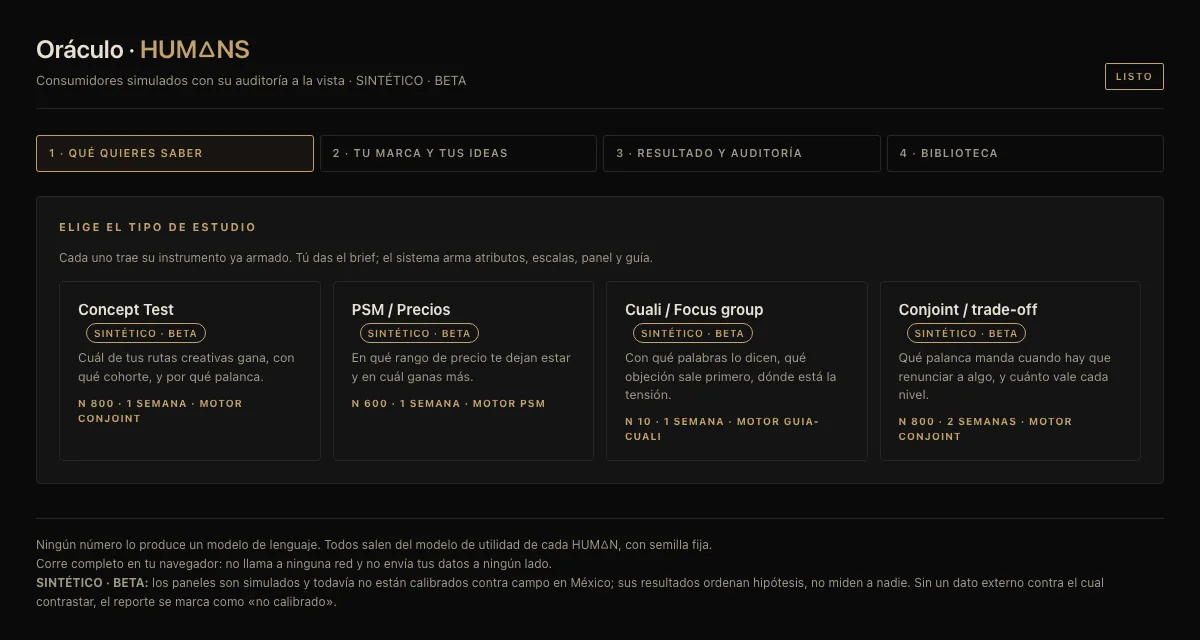
- Concept test
- which of your creative routes wins, with which cohort, and on which lever
- PSM · pricing
- what range the market lets you be in, and where you earn most
- Quali
- in what words they say it, and which objection surfaces first
- Conjoint
- which lever wins when something has to be given up
Who it's for, and what question they bring
What it looks like when it runs: Caribe Cooler
RTD · Mexico · August 2026 · seed 20260808
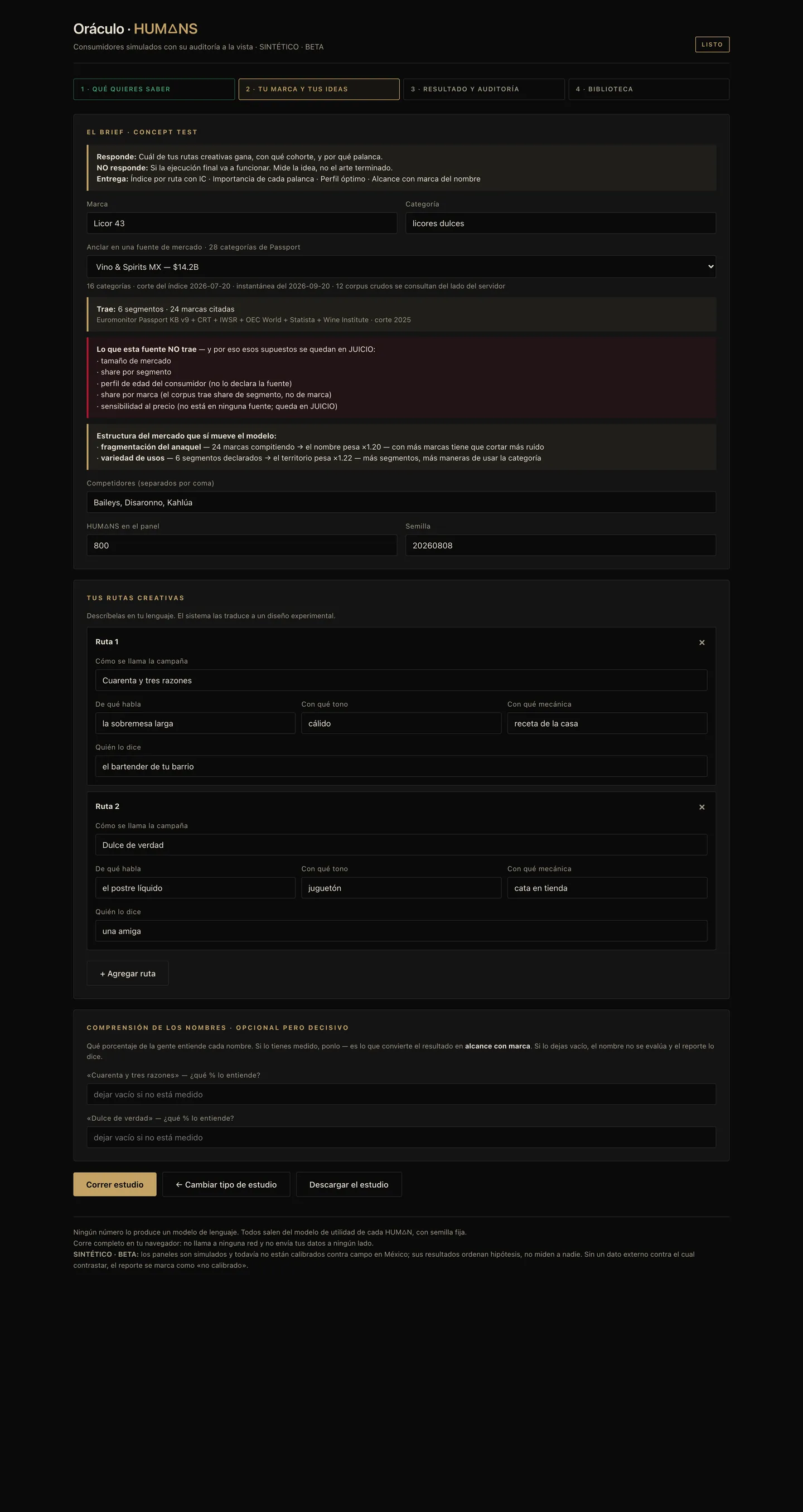
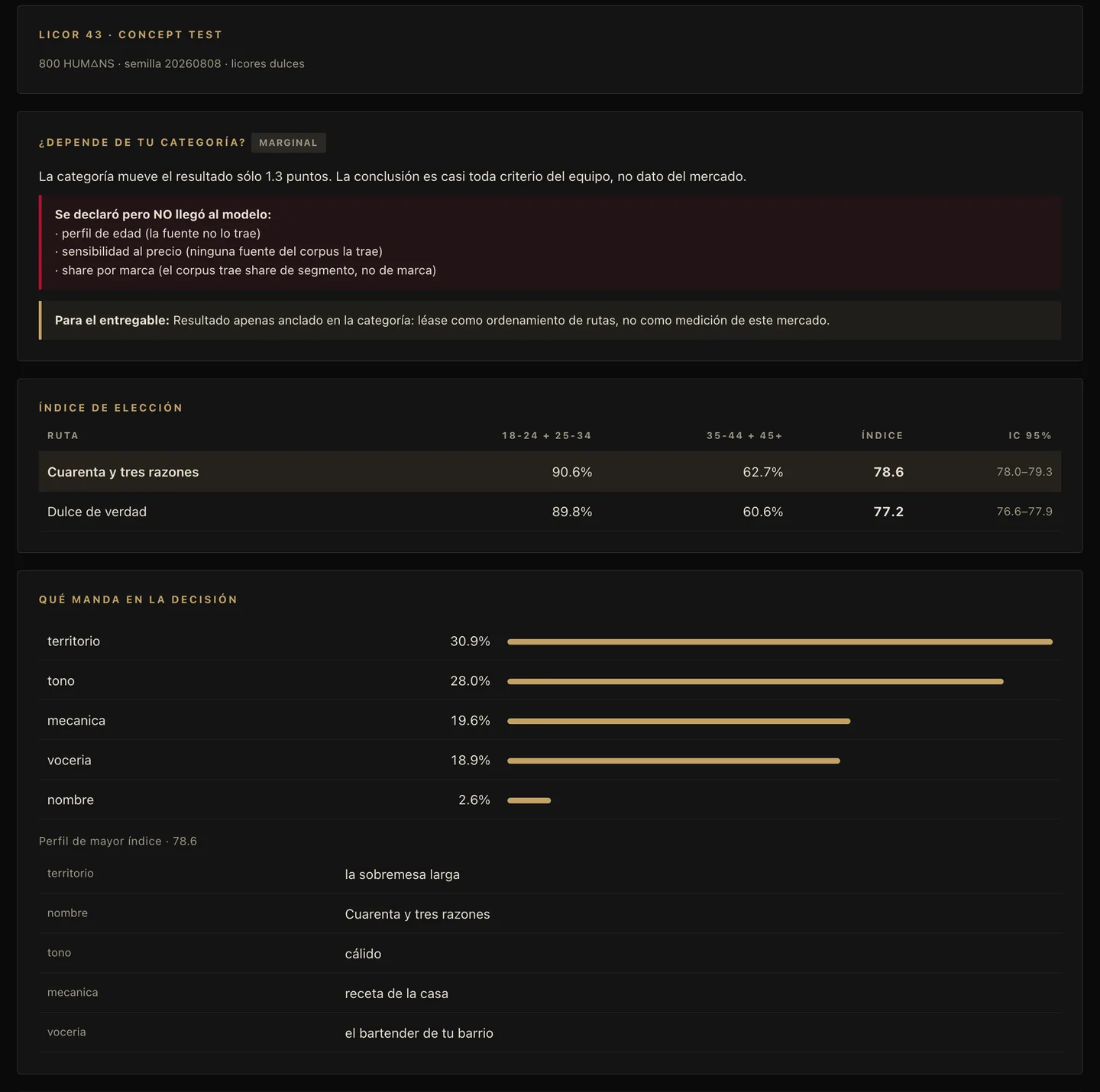
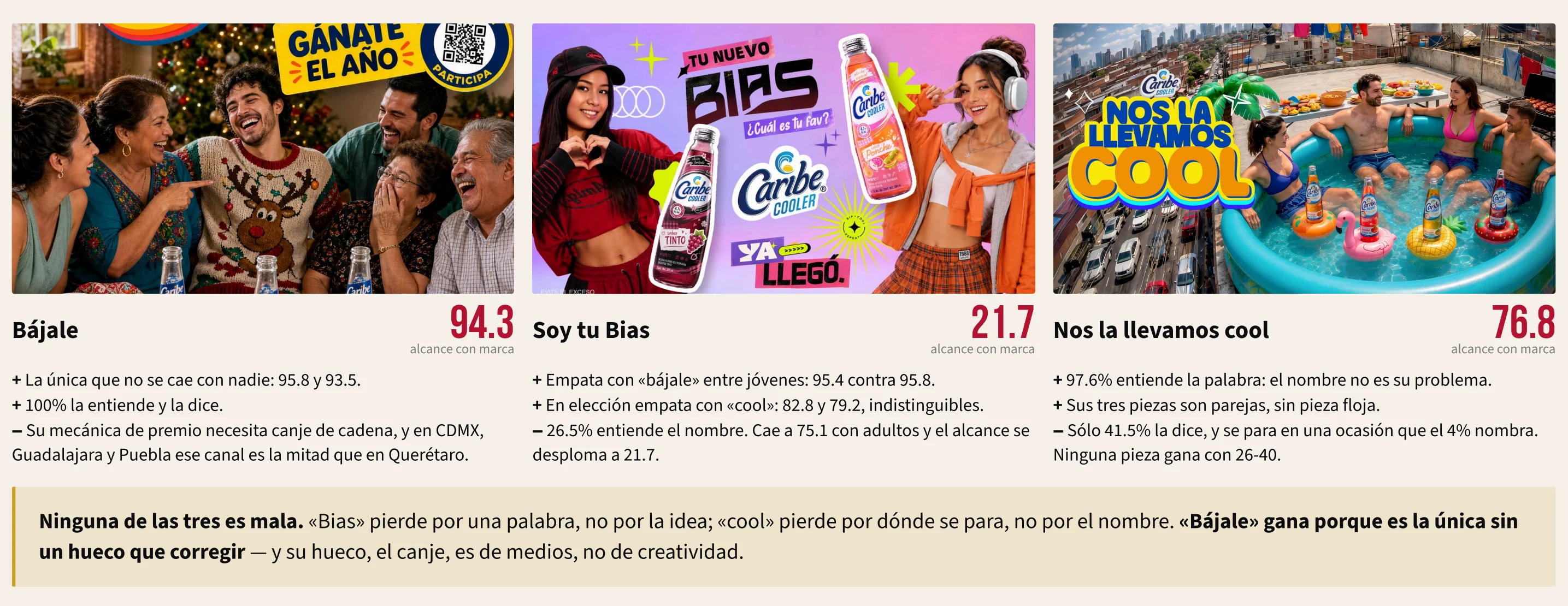
The brand had three campaign routes and had to decide which one to pay for: Bájale, Nos la llevamos cool and Soy tu Bias. Against New Mix, Smirnoff Ice and Topo Chico Hard Seltzer.

What was fielded
- Panel
- 1,500 profiles across five weighted cohorts aged 18 to 40, with three modeled traits —youth, fandom, nostalgia— and their deviation by cohort
- Conjoint
- five attributes (territory, name, tone, mechanics, voice), 10 tasks, 3 alternatives, 400 bootstrap repetitions and 10 audit seeds
- Group
- 800 people, 166 interventions across seven segments: opening, warm-up, body, stimulus, laddering, projective and close
- Control
- one fixed comparison cell, so the winner is measured against something, not against itself
The finding that changed the decision
Name comprehension, measured cohort by cohort:
«Soy tu Bias» is understood by 41% of 18–25-year-olds and only by 14.8% of those over 26. Five out of six people in the category's largest group wouldn't know what it's talking about. That's a national campaign falling apart before it's even bought — and it took one week to find out.
What they said, in their own words
«Michelada, mezcal with something mixed in, those flavored vodka cans that are trendy now, a club with really ugly lights, and prices that go up at the supermarket for no reason.»
18–21 · warm-up«Honestly, they should stop messing with something that's already good. If a brand works for me, I stick with it — I don't need them changing it every five minutes with some new angle.»
26–30 · closeAnd here the product corrects itself
The group was checked against what people actually search for online about the brand. Six topics turned out to be blind spots, and six came up on their own:
What the group never touched, and people do ask
- What it's made of50 searches
- How strong it hits4 questions
- How it's drunk3
- Who makes it3
- Effect on the body3
- What it tastes like2
What the group brought up on its own
- Price64 mentions
- Get-together occasion58
- Belonging / neighborhood44
- «Sounds fake»18
- Doesn't understand the name5
- Smoothness5
It doesn't say the group is wrong. It says the guide never asked.
That's the line the system writes on its own — and it writes the consequence too: those six topics go into the guide before any more qualitative work is fielded in the category. A tool that only confirms what you ask it isn't useful for deciding anything.
How far the model goes, and where the data takes over
Comprehension of «bias» has a measured ceiling of 55.8% — what people search for doesn't support more than that. The model places it at 26.5%, which fits under that ceiling. The ceiling is data; the position within the ceiling is model, and the two are labeled separately.
With «bájale» it's the opposite: nobody searches for what it means. The ceiling sits at 100% and restricts nothing — and that absence of searches is behavioral evidence that it's understood. It's the cheapest one there is.
It's in beta, and the product says so — not the fine print
Without an external data point to check against, the report gets marked «not calibrated». No number comes from a language model: every one comes from each profile's utility model, with a fixed seed — the same question gives the same result.
And if you already have something ready
Send me the campaign you're about to pay for.
Before the market tells you whether it worked —once it's already charged you for the mistake— we tell you. And if we have no way to measure your category, we tell you that too, no quote required.